Wu
Wundt, Wilhelm (1832 - 1920)
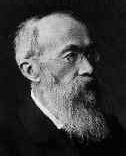 The German physiologist and psychologist, Wm. Wundt proposed that two different sciences were required for the study of the human mind: Experimental Psychology and Völkerpsychologie. Experimental or “subjective” psychology aimed to trace elementary psychic experiences and reactions to physiological processes using introspection of trained subjects. Völkerpsychologie covered the territory that Dilthey had opened up in his descriptive psychology.
Graduating in medicine from the University of Heidelberg in 1856, Wundt studied briefly with Johannes Müller, before joining the University of Heidelberg, where he became an assistant to Hermann von Helmholtz in 1858. There he wrote “Contributions to the Theory of Sense Perception” (1858-62).
It was during this period that Wundt offered the first course ever taught in scientific psychology. Until then, psychology had been regarded as a branch of philosophy to be conducted primarily by rational analysis. Wundt instead stressed the use of experimental methods drawn from the natural sciences. His lectures on psychology were published as “Lectures on the Mind of Humans and Animals” (1863).
Bypassed in 1871 for the appointment to succeed Helmholtz, Wundt then applied himself to writing a work that came to be one of the most important in the history of psychology, “Principles of Physiological Psychology” (1874). The “Principles” advanced a system of psychology that sought to investigate the immediate experiences of consciousness, including sensations, feelings, volitions, apperception and ideas using introspection.
Wundt recognized the two different objective processes involved in Psychology: culture and physiology. The physiological basis of psychology could be studied by methods of introspection. Völkerpsychologie, however, could not be studied by laboratory methods because the higher psychological functions extend beyond individual human consciousness, for example, in the construction of languages and social institutions. Völkerpsychologie requires the use of a developmental-historical methodology, and must therefore incorporate ethnology, the “science of the origins of peoples.”
“Its problem relates to those mental products which are created by a community of human life and are, therefore, inexplicable in terms merely of individual consciousness, since they presuppose the reciprocal action of many ... Individual consciousness is wholly incapable of giving us a history of the development of human thought, for it is conditioned by an earlier history concerning which it cannot give us any knowledge.”
In 1871, Wundt began publication of a scientific journal of psychology, “Philosophical Studies.” In 1875 he took up a position at the University of Leipzig and in 1879, established the first psychological laboratory in the world, where the founders of both American and Russian Behavourism, Edward Titchener and Vladimir Bekhterev, studied.
See Wundt's 1896 Outline of Psychology.