Th
Thalheimer, August (1884-1948)
A member of the German Social Democratic Party before the First World War, and editor of one of its papers, the Volksfreund. From 1916 he assisted in the production of the Spartakusbriefe, and was a member of the USPD (Independent Socialists) from 1917, and a founder member of the German Communist Party (KPD). He quickly rose to prominence as the party’s main theoretician, being editor of Rote Fahne as well as of Franz Mehring’s manuscripts left unpublished at his death.
During the 1923 crisis he was Minister of Finance in the Württemburg local government, was subsequently blamed along with Brandler for the debacle, and was called to Moscow in 1924, where he worked in the Communist International apparat, as well as for the Marx-Engels Institute. His lectures delivered at the Sun Yat-Sen University in 1927 were published as a textbook in philosophy (which appeared in English as Introduction to Dialectical Materialism, New York, 1936), and he also worked on the draft programme of the Comintern along with Bukharin. Pressure from the KPD, still uneasy with the leadership of Thälmann, secured his return to Germany in 1928, but a year later he was expelled from the KPD along with Brandler, and they went on to form the KPO, or Brandlerites.
The Brandlerite organisation restricted most of its criticisms to the foreign policy of the Soviet Union, whilst maintaining that its domestic operations were basically healthy. Thalheimer insisted that: ‘We do not want to draw the conclusion that as the politics of the Comintern are wrong, it must follow that the politics of Russia are also wrong.’ (GdST, 4/1931) Thalheimer himself supported forced collectivisation and Stakhanovism, and whilst in Barcelona became involved in a heated argument with Andres Nin over the POUM's condemnation of the first Moscow Trial.
In exile in Paris from 1932 onwards, Thalheimer went to Spain in 1936, and then back to France again where the KPO’s exile organisation worked. When six members of the KPO were arrested in Barcelona by the Stalinists and charged with the usual crimes in July 1937, he issued a statement co-signed by Brandler saying that:
‘We take upon ourselves any political and personal guarantee for our arrested comrades. They are anti-Fascists and revolutionaries, incapable of any action that could be construed as high treason to the Spanish Revolution.’
They were not to stay long in Paris. In 1940 France fell to Hitler, and Thalheimer fled to Cuba, where he died in 1948.
Thangathurai, C.
Member of the Bolshevik Leninist Party of India. Worked in Pannaipuram (Theni District, Tamil Nadu). Joined RWPI.
Compiled by Charles Wesley Ervin
Tharmakulasingham, Chellapa (? – 1949)
Party pseudonym: Jeyam
Born Point Pedro (Jaffna province), Ceylon, into a high-caste (Vellala) family. Educated Jaffna College, Vaddukkoddai, Ceylon. Practiced law. Regarded as the first Tamil Marxist in Ceylon. Organized the bus workers and cigar workers in Jaffna Pennisula. Helped form the North Ceylon Workmen’s Union and North Ceylon Vehicleman’s Union. President, North-Ceylon Bus Workers Union and Cigar Workers Union. Joined Lanka Sama Samaja Party, giving the party its first trade union base in the North. Challenged the communal politics of G.G. Ponnambalam. Sided with Philip Gunawardena in the post-war split in LSSP. Ran for Parliament from Point Pedro Constituency on LSSP ticket, 1947. Died young of liver disease. “Tharmakulasingham Day” used to be celebrated every July in Jaffna in his honor. His nephew, Kethish Loganathan, was a leading figure in contemporary Tamil politics until he was assasinated in 2006.
Compiled by Charles Wesley Ervin
Thiers, Louis Adolphe (1797-1877)
French politician, journalist, and revisionist historian. First president of the Third Republic (1871-73). Thiers was particularly noted for his brutality in crushing all popular rebellions against the monarchy, particularly at Duchesse de Berry in 1832 and of the Republicans in 1834.
Under the Orleanist monarchy, Thiers was undersecretary of state for the treasury (1830), minister of the interior (1832 and 1834-36), minister of trade and public works (1833-34), premier and minister of foreign affairs (1836 and 1840). Later assisted Louis Bonaparte in 1848 to attain the throne, and became a deputy under his government of the Second Empire. Leading up to 1870, Thiers strongly agitated for a war with Prussia, but when France’s armies suffered defeat after defeat (this all within a period of a few weeks), Thiers quickly changed his policy, and "spoke out against the war" when France had already but lost. Through his maneuvering, he placed himself in a victorious political position after France’s crushing defeat in the war, despite his entire career of agitatation for war. Thiers accomplished this separating himself as far as possible from the Government of National Defense, the government which would be forced to surrender and sign the treaty with Germany. With the treaty signed, Thiers triumphantly entered the scene and called for national elections: Thiers was elected to 26 different departments; on Feb. 17, 1871 Thiers was elected the "chief executive power of the republic", and in August became the first president of the Third Republic. In May, 1871, Thiers sent French soldiers, with the support of the Germans, into Paris to brutally tear apart the Paris Commune. Thiers resigned his post in 1873, and died in September 1877.
Theirs, that monstrous gnome, has charmed the French bourgeoisie for almost half a century, because he is the most consummate intellectual expression of their own class corruption. Before he became a statesman, he had already proved his lying powers as an historian. The chronicle of his public life is the record of the misfortunes of France. Banded, before 1830, with the republicans, he slipped into office under Louis Philippe by betraying his protector Lafitte, ingratiating himself with the king by exciting mob riots against the clergy, during which the church of Saint Germain l’Auxerrois and the Archbishop’s palace were plundered, and by acting the minster-spy upon, and the jail-accoucheur of the Duchess de Berry. The massacre of the republicans in the Rue Transnonian, and the subsequent infamous laws of September against the press and the right of association, were his work. Reappearing as the chief of the cabinet in March 1840, he astonished France with his plan for fortifying France.....Theirs was consistent only in his greed for wealth and his hatred of the men that produce it. Having entered his first ministry, under Louis Philippe, poor as Job, he left it a millionaire....
Karl Marx
The Civil War in France: Chapter 3
Thomas, Albert (1878-1932)
French parliamentary deputy and one of the leaders of the right wing of the French Socialist Party and the Second International. Upon the outbreak of the First World War Albert Thomas became one of the most fervent social-imperialists. On May 22, 1915 he entered Clemenceaus government as Minister of Military Supplies. In 1916 he made a visit to Russia to present himself to the Tsar. He made a further visit to Petrograd in 1917 along with other representatives of the Second International, Henderson and Vandervelde with the object of exerting pressure on the then Social revolutionary-Menshevik controlled Soviet in favour of carrying through the war to a victorious conclusion. In the 1920s Thomas headed the International Labour Office of the League of Nations whose aim was the peaceful and painless solution of conflicts between capital and labour by averting strikes and armed clashes, etc.
Thomas, James H. (1874-1949)
Leader of the British rail-road union, colonial secretary in the first Labour government and lord privy seal in the second. He deserted the Labour Party in 1931 to help Ramsey MacDonald set up a coalition government with the Tories.
Thomas, Norman (1884–1968)
 Leading American socialist, pacifist, and six-time presidential candidate for the Socialist Party of America.
Early years
Norman Mattoon Thomas was born November 20, 1884 in Marion, Ohio, the oldest of six children of a Presbyterian minister. Thomas had an uneventful midwestern childhood, helping to put himself through Marion High School as a paper carrier for Warren G. Harding’s Marion Daily Star. Like other paper carriers, he reported directly to Florence Kling Harding. “No pennies ever escaped her,” said Thomas. The summer after he graduated from high school his father accepted a pastorate at Lewisburg, Pennsylvania, which allowed Norman to attend Bucknell University. He left Bucknell after one year to attend Princeton University, the beneficiary of the largesse of a wealthy uncle by marriage. Thomas graduated magna cum laude from Princeton University in 1905.
After some settlement work and a trip around the world, Thomas decided to follow in his father’s footsteps and enrolled in Union Theological Seminary. He graduated from the seminary and was ordained as a Presbyterian minister in 1911. After assisting the Rev. Henry Van Dyke at the fashionable Brick Presbyterian Church on Manhattan’s Fifth Avenue, Thomas was appointed as pastor for the East Harlem Presbyterian Church, ministering to Italian-American Protestants. Union Theological Seminary had been, at that time, a center of the Social Gospel movement and liberal politics, and as a minister, Thomas preached against American participation in the First World War. This pacifist stance led to his being shunned by many of his fellow alumni from Princeton, and opposed by some of the leadership of the Presbyterian Church in New York. When church funding of the American Parish’s social programs was stopped, Thomas resigned his pastorate. Despite this resignation of his position, Thomas did not formally leave the ministry until 1931, after his mother’s death.
It was Thomas’ position as a conscientious objector which drew him to the Socialist Party of America (SPA), a staunchly antimilitarist organization. When SPA leader Morris Hillquit made his campaign for Mayor of New York in 1917 on an anti-war platform, Thomas wrote to him expressing his good wishes. To his surprise, HIllquit wrote back, encouraging the young minister to work for his campaign, which Thomas energetically did. Soon thereafter he himself joined the Socialist Party. Despite his membership in the Marxist SPA, Thomas was never himself an orthodox Marxist, instead favoring a Christian socialist orientation.
Thomas was the secretary of the pacifist Fellowship of Reconciliation even before the war, then an unpaid position. When the organization started a magazine called The World Tomorrow in January 1918, Thomas was employed as its paid editor. Together with his co-thinker Devere Allen, Thomas helped to make The World Tomorrow the leading voice of liberal Christian social activism of its day. In 1921, Thomas moved to secular journalism, when he was employed as associate editor of The Nation magazine.
In 1922 Thomas became co-director of the League for Industrial Democracy. Later, he was one of the founders of the National Civil Liberties Bureau (the precursor of the American Civil Liberties Union).
Electoral politics
Thomas ran for office four times in quick succession on the Socialist ticket—for Governor of New York in 1924, for Mayor of New York in 1925, for New York State Senate in 1926, and for New York City Alderman in 1927. None of these campaigns were particularly successful. Nevertheless, following Eugene Debs’ death in 1926, there was a leadership vacuum in the Socialist Party. Neither of the party’s two top political leaders—Victor L. Berger and Hillquit—were eligible to run for President of the United States by virtue of their foreign birth. The third main figure, Daniel Hoan was occupied as Mayor of Milwaukee, Wisconsin. Down to approximately 8,000 dues paying members, the Socialist Party’s options were limited, and the little known minister from New York with oratorial skills and a pedigree in the movement became the choice of the 1928 National Convention of the Socialist Party as its standard bearer.
The 1928 campaign marked the first of campaigns of Thomas as the Presidential nominee of the Socilaist Party. As an articulate and engaging spokesman for democratic socialism, Thomas’ influence was considerably greater than that of the typical perennial candidate. Although socialism was viewed as an unsavory form of political thought by most middle-class Americans, the well-educated Thomas—who often wore three-piece suits—looked like and talked like a president and gained grudging admiration.
Thomas frequently spoke on the difference between socialism and Communism, explaining the differences between the movement he represented and that of revolutionary Marxism. His early admiration for the Russian Revolution subsequently turned into devout anti-Communism. (The revolutionaries thought him no better; Leon Trotsky, on more than one occasion, levelled high-profile criticism at Thomas, accusing Thomas of ‘...considering himself a socialist by the result of a misunderstanding.’) He wrote several books, among them his passionate defense of World War I conscientious objectors, Is Conscience a Crime?, and his statement of the 1960s social democratic consensus, Socialism Re-examined.
Socialist Party politics
Thomas failed to isolate himself from the rough and tumble internal factional politics of the Socialist Party, as his predecessor Debs had been able to do. At the 1932 Milwaukee Convention, Thomas and his radical pacifist allies in the party joined forces with constructive socialists from Wisconsin and a faction of young Marxist intellectuals called the “Militants” in backing a challenger to National Chairman Morris Hillquit. While Hillquit and his cohort retained control of the organization at this time, this action earned the lasting enmity of Hillquit’s New York-based allies of the so-called “Old Guard”. The diplomatic party peacemaker Hillquit died of tuberculosis the following year, lessening the stability of his faction.
At the 1934 Convention, Thomas’ connection with the Militants was deepened when he backed a radical Declaration of Principles authored by his long-time associate from the radical pacifist journal The World Tomorrow, Devere Allen. The Militants swept to majority control of the party’s governing National Executive Committee at this gathering, and the Old Guard retreated to their New York fortress and formalized their factional organization as the Committee for the Preservation of the Socialist Party, complete with a shadow Provisional Executive Committee and an office in New York City.
Although Thomas himself favored work to establish a broad Farmer-Labor Party upon the model of the Canadian Cooperative Commonwealth Federation, he nonetheless remained supportive of the Militants and their vision of an “all-inclusive party,” which welcomed members of dissident communist organizations (including Lovestoneites and Trotskyists) and worked together with the Communist Party USA in joint Popular Front activities. The party descended into a maelstrom of factionalism in the interval, with the New York Old Guard leaving to establish themselves as the Social Democratic Federation of America, taking with them control of party property, such as the Yiddish-language Jewish Daily Forward, the English-language New York Leader, the Rand School of Social Science, and the party’s summer camp in Pennsylvania. The party was left in dire financial circumstances. As the social democratic Marxists of the Old Guard were expelled and left the SP in 1936, revolutionary Marxists from the Workers Party of the United States were admitted en masse. Disagreements among the Militant faction led it to shatter into three rival groups, a Right Wing headed by Jack Altman, a Center group called “Clarity” headed by Herbert Zam and Gus Tyler, and a Trotskyist revolutionary Left Wing faction called the “Appeal” group after the name of their factional newspaper.
In 1937 Thomas returned from Europe determined to restore order in the Socialist Party. He and his followers in the party teamed up with the Clarity majority of the National Executive Committee and gave the green light to the New York Right Wing to expel the Appeal faction from the organization. These expulsions led to the departure of virtually the whole of the party’s youth section. Demoralization set in and the Socialist Party withered, its membership level below the lowest nadir of 1928.
Causes
Thomas was initially as outspoken in opposing the Second World War as he was with regard to the First World War. Upon returning from a European tour in 1937, he formed the Keep America Out of War Congress and spoke against war, thereby sharing a platform with the right wing isolationist America First Committee. However, after the United States was attacked by the Japanese at Pearl Harbor, his stance changed to support for US involvement , and later wrote self-critically for having “overemphasized both the sense in which it was a continuance of World War I and the capacity of nonfascist Europe to resist the Nazis.”. Norman Thomas, 1962
Thomas was one of the few public figures to oppose the internment of Japanese Americans following the attack on Pearl Harbor. Thomas accused the ACLU of “dereliction of duty” when the organization supported the internment. Thomas also campaigned against racial segregation, environmental depletion, anti-labor laws and practices, and in favor of opening the United States to Jewish victims of Nazi persecution in the 1930s.
Thomas was an early proponent of birth control. The eugenicist Margaret Sanger recruited him to write “Some Objections to Birth Control Considered” in Religious and Ethical Aspects of Birth Control, edited and published by Sanger in 1926. Thomas accused the Roman Catholic Church of hypocritical opinions on sex, such as requiring priests to be celibate and maintaining that lay people should only have sex to reproduce. “This doctrine of unrestricted procreation is strangely inconsistent on the lips of men who practice celibacy and preach continence.”
Thomas also deplored the secular objection to birth control because it originated from “racial and national” group-think. “The white race, we are told, our own nation—whatever that nation may be—is endangered by practicing birth control. Birth control is something like disarmament—a good thing if effected by international agreement, but otherwise dangerous to us in both a military and economic sense. If we are not to be overwhelmed by the ’rising tide of color’ we must breed against the world. If our nation is to survive, it must have more cannon and more babies as prospective food for the cannon.”
Later years
After 1945 Thomas sought to make the non-Communist left the vanguard of social reform, in collaboration with labor leaders like Walter Reuther. He championed many seemingly unrelated progressive causes, while leaving unstated the essence of his political and economic philosophy.
In 1961, Thomas released an album The Minority Party in America: Featuring an Interview with Norman Thomas, on Folkways Records, which focused on the role of the third party.
Thomas’ 80th birthday in 1964 was marked by a well-publicized gala at the Hotel Astor in Manhattan. At the event Thomas called for a cease-fire in Vietnam and read birthday telegrams from Hubert Humphrey, Earl Warren, and Dr. Martin Luther King, Jr. He also received a check for $17,500 in donations from supporters. “It won’t last long,” he said of the check, “because every organization I’m connected with is going bankrupt.”
Thomas died on December 19, 1968.
The Norman Thomas High School in Manhattan and the Norman Thomas ’05 Library at Princeton University’s Forbes college are named after him. He was also the grandfather of Newsweek columnist Evan Thomas.
A plaque in the Norman Thomas ’05 Library reads: Norman M. Thomas, class of 1905. “I am not the champion of lost causes, but the champion of causes not yet won.”
Thompson, Edward Palmer (E.P.) (1924-1993)
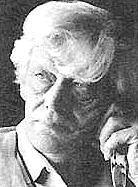 English Marxist historian, generally acknowledged as the greatest English historian of the twentieth century, a dedicated peace activist, superb polemicist and radical visionary.
His parents had been missionaries in India, on friendly terms with Gandhi and Nehru, and one of Thompson’s last projects was a study of his father’s close involvement in the life and work of the poet Rabindranath Tagore.
Like his brother Frank Thompson joined the Communist Party during the Second World War, and he returned from service in a tank regiment in Italy to complete a degree in history at Cambridge.
In 1948 he married Dorothy Towers, who remained his collaborator and companion to the end. While an extra mural Lecturer at Leeds, he a produced a major reinterpretation of William Morris, William Morris: Romantic to Revolutionary (1955), and then his most famous and monumental work, The Making of the English Working Class (1963).
During this period, Thompson was active in the peace movement, first with the British Peace Committee, then with CND on its formation in 1957, active against the wars in Korea, Kenya, Malaya, Cyprus and Algeria; Following the Soviet repression of the Hungarian Uprising, he resigned from the Communist Party, founding of the New Reasoner, the English ‘socialist humanist’ magazine which reflected the rise of socialist-humanism in Eastern Europe. The New Reasoner amalgamated with another ‘socialist humanist’ journal to form the New Left Review. However, Thompson increasing came into conflict with the editors of the New Left Review in opposition to rationalist and anti-humanist interpretations of Marxism, culminating in 1978 with his onslaught on ‘Stalinism in theory’ of The Poverty of Theory — calling on Marxist intellectuals return to the program of the (old) New Left outlined in the Epistle to the Philistines of 1957.
In the meantime, the main target of Thompson’s polemic had shifted, and the sixties were spent inveighing not so much against Stalinism, but the philistinism of ‘Natopolitanism’ and the apathy of the Labour Left and CP dissenters in leaving capitalism to ‘rot on the bough’ when Britain was over-ripe for socialism. Thompson’s solidarised with the student protest at the corporatism of Warwick University where worked, but resigned in disgust in 1971, never again to take up an academic position.
In his pursuit of a “third way” to end the Cold War, Thompson spent a decade as a roving ambassador on the international peace circuit, helping to open up dialogue across the Iron Curtain separating peace activists on either side. Of all the Left theorists of his generation, Thompson had by far the widest international audience, and the consistent anti-chauvinism of his peace movement perspective was legendary.
See Obituary by Duncan Hallas and E P Thompson Archive
Thoreau, Henry David (1817-1862)
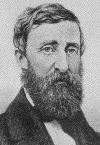 American essayist, poet, and ethicist, best-known for his autobiographical story of life in the woods, Walden (1854). His Civil Disobedience (1849) influenced Gandhi and Martin Luther King.
Henry David Thoreau was born in Concord, Massachusetts, and graduated from Harvard University in 1837. From 1837-38 Thoreau worked in his father’s pencil factory, and later in 1844 and 1849-50. He opened a school in Concord with his brother John and taught there in 1838-41 until his brother died. From 1848 he was a regular lecturer at Concord Lyceym and worked as a land surveyor.
1841-43 and 1847-48, Thoreau worked as a handyman in the Emerson household where he met Ralph Waldo Emerson, the poet and Transcendentalist. In 1845 Thoreau built a home on the shores of Walden Point for twenty-eight dollars, and his Spartan style of living at Walden was the basis for his advocacy of the simple life, Walden; or, Life in the Woods, for which he is famous.
His most famous essay, Civil Disobedience was a result of a overnight imprisonment in 1846 when he refused to pay his taxes in protest against the Mexican War and the extension of slavery. Later Thoreau lectured and wrote about the evils of slavery and helped fleeing slaves.
See Civil Disobedience.
Thorez, Maurice (1900-1964)
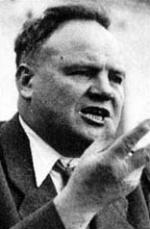 Thorez went to work in the coal mines at the age of 12 and joined the French Socialist Party in 1919, but soon after, joined the Communist Party, and became the party’s Secretary General during the “third period” in 1930.
He was elected to the Chamber of Deputies in 1932 and following the Comintern directive, formed a the Popular Front with the Socialist Party and the Radical Socialists and following the 1936 elections Leon Blum became Prime Minister of a Popular Front government.
Following the Hitler-Stalin Pact of 1939 however, the Communist Party was excluded from the government and Thorez went into exile in the Soviet Union, returning to France only after Liberation in 1945.
A popular front with the Socialist Party in the 1945 elections saw Thorez Deputy Prime Minister from 1946 to 1947. His health deteriorated, though he remained Party Chairman, until shortly before his death in 1964.
Thorne, Will (1857-1946)
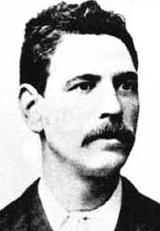 Son of a brickyard labourer, Will Thorn was born in Birmingham on 8th October, 1857. At the age of six Thorne began work for a rope and twine spinner. The death of his father in 1864 dramatically reduced the family income. Mrs. Thorne found employment sewing hooks and eyes on cards and William found work in the local brickyard.
Over the next few years Thorne did a variety of different jobs including a lath splitter, handyman and plumber’s mate. However, by the age of sixteen Thorne was back working in the brickyards. In 1875 Thorne’s mother remarried a local carpenter. Her new husband was an alcoholic and so Thorne decided to leave home and go on the “tramp.”
After a period as a navvy Thorne returned to Birmingham and found work at the Saltley Gas Works. In 1879 the twenty-two year old Thorne married Harriet Hallam, the daughter of one of Thorne’s fellow workers at Saltley. Both Will Thorne and his wife were illiterate and were unable to sign their names on the marriage certificate.
In 1882 Will and Harriet and their two children moved to London. Thorne found work at the Beckton Gasworks. Soon after arriving in the capital Thorne joined the Canning Town branch of the Social Democratic Federation (SDF). Thorne was appointed secretary of the branch and began attending national meetings of the organisation where he met H. M. Hyndman, George Bernard Shaw, Tom Mann, John Burns, Edward Aveling and Friedrich Engels.
One of the members of the SDF, Eleanor Marx, helped to teach Thorne how to read and write. Thorne’s confidence in his abilities gradually grew and by the late 1880s he was one of the SDF’s best known public speakers. At this time Thorne considered himself a communist and named one of his sons after Karl Marx.
In 1889 Thorne helped to establish the National Union of Gasworkers & General Labourers. He then defeated Ben Tillett in the election for the post of General Secretary of the union. Thorne led the successful negotiations for an eight hour day in the industry. As they previously did twelve hour shifts this was a great advert for union power and the Gasworkers’ Union soon had over 20,000 members.
Will Thorne’s success also inspired other unions to demand better pay and conditions. The most important of these was the London Dock Strike led by Ben Tillett in 1889. The dockers demanded four hours continuous work at a time and a minimum rate of sixpence an hour. The employers hoped to starve the dockers back to work but Thorne and other trade union activists such as John Burns, Eleanor Marx, James Keir Hardie and H. H. Champion, gave valuable support to the 10,000 men out on strike. Organizations such as the Salvation Army and the Labour Church raised money for the strikers and their families. Trade Unions in Australia sent over £30,000 to help the dockers to continue the struggle. After five weeks the employers accepted defeat and granted all the dockers’ main demands.
Thorne was now seen as a dangerous man and attempts were made to weaken the Gasworkers’ Union. South Metropolitan Gas Company introduced a profit sharing scheme for the workforce and during the strike in 1890 the Leeds Gas Company sacked union members. When the Gasworkers’ Union forced the company to reinstate the workers, Friedrich Engels was so impressed with Thorne’s leadership he gave him an autographed copy of Das Kapital.
In 1894 Thorne was elected to the Trades Union Congress Parliamentary Committee (a position he held until 1933). Thorne was also active in local politics and in West Ham served as a Town Councillor (1891-1910), Alderman (1910-46) and Mayor (1917-18).
Thorne helped Keir Hardie win the West Ham seat in the 1892 General Election. After Hardie was defeated in 1895 and moved to Merthyr Tydfil, Thorne became the Labour Party candidate in West Ham. Defeated in the 1900 General Election he finally won the right to represent West Ham in the House of Commons in the 1906 General Election.
Unlike many of his former colleagues in the Social Democratic Federation, Thorne supported Britain’s involvement in the First World War. He joined the West Ham Volunteer Force with the rank of Lieutenant-Colonel. His eldest son also joined the army and was killed at Ypres in 1917.
Thorne was one of the MPs chosen to visit Russia during the revolution of 1917. When he returned he had meetings with both the Prime Minister, David Lloyd George, and King George V.
In the 1918 General Election Thorne won the Plaistow seat for the Labour Party. He held this new seat until his retirement before the 1945 General Election. Will Thorne died on 2nd January, 1946.